Flutter Versus Native Development for Your App
A mobile app can look nearly identical in a product demo whether it is built with Flutter or native code. The differences tend to surface later: when a new iOS release changes a critical permission flow, when a field team needs reliable offline sync, or when a fast-growing customer base exposes a performance bottleneck. Flutter versus native development is not simply a technical preference. It is a product, budget, risk, and long-term support decision.
For founders and business leaders, the right answer depends on what the app must accomplish, who will use it, and how much platform-specific capability sits behind the experience. A thoughtful decision early in discovery can prevent expensive rework after launch.
What Flutter and Native Development Actually Mean
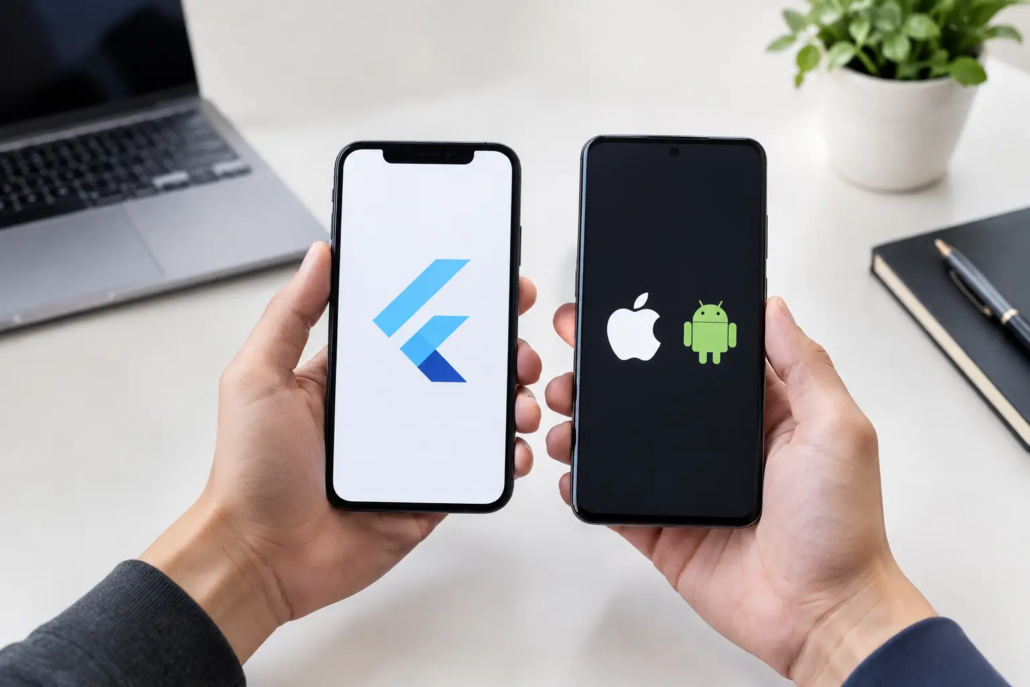
Flutter is a cross-platform framework that enables developers to build iOS and Android applications from one shared codebase, primarily using the Dart programming language. Rather than relying on each platform’s standard user-interface controls for every screen, Flutter renders much of its own interface. That approach creates strong visual consistency across devices and supports fast iteration.
Native development means building separately for each mobile operating system: Swift or Objective-C for iOS and Kotlin or Java for Android. The applications use the platforms’ own tools, interface components, and APIs directly. Although native projects require more platform-specific development work, they offer the closest alignment with the operating systems they run on.
Neither approach is automatically more professional or more scalable. Both can support successful consumer, enterprise, and operational applications. The relevant question is which approach best supports your product roadmap without creating unnecessary cost or technical constraints.
Flutter Versus Native Development: The Business Trade-Offs
Speed to MVP and early market validation
Flutter often has a meaningful advantage when the initial product requires comparable functionality on iOS and Android. A shared codebase can reduce duplicated engineering effort, simplify design implementation, and make it easier to release feature updates on both platforms at the same time.
That efficiency is especially valuable for an MVP that needs to test a clear market assumption: Will users adopt the workflow? Will a subscription model convert? Does a customer portal reduce support volume? When the product centers on forms, account management, content, dashboards, scheduling, commerce, or standard integrations, Flutter can help a business reach the learning phase sooner.
But speed should not be measured only by the date of the first release. If the MVP depends on advanced Bluetooth connections, custom camera processing, real-time mapping, health data, complex background operations, or specialized hardware, native development may move faster over the full project lifecycle. Starting with Flutter only to build substantial native modules later can erase the expected savings.
Cost and team efficiency
One shared Flutter application can lower the initial cost of serving two platforms, particularly when requirements are well defined and the interface is largely consistent. Maintenance can also be more efficient because many fixes and feature enhancements are handled in one place.
Native development has higher upfront costs because iOS and Android code must be created, tested, and maintained independently. It also requires enough process discipline to keep feature behavior aligned across platforms. For a business evaluating proposals, that higher investment should not be treated as waste. It buys direct access to each platform and can reduce complexity in highly technical applications.
The practical financial comparison is not Flutter versus two full native apps in the abstract. It is the projected cost of building, operating, updating, and expanding the specific app you intend to own for several years.
Performance and user experience
Native applications generally provide the most direct path to maximum performance, especially for graphics-heavy experiences, intensive animations, low-latency interactions, or workloads that run extensively in the background. They also make it easier to adopt the newest iOS and Android features as soon as they become available.
Flutter delivers excellent performance for many business applications and can produce polished, responsive interfaces. Users do not choose an app because its technology stack is fashionable. They notice whether it loads quickly, behaves predictably, and makes a task easier to complete.
The distinction matters when performance is part of the value proposition. A consumer app with rich motion, a telematics product processing continuous data, or a construction tool used in low-connectivity conditions deserves technical validation before a platform decision is finalized. A prototype of the riskiest workflow is more useful than assumptions about framework performance.
Platform-specific behavior and integrations
iOS and Android users have different expectations, and the operating systems provide different capabilities. Native development gives a team complete control over those differences. It is often the preferred route when an app must deeply integrate with device features, use new operating system APIs immediately, or follow each platform’s interaction conventions closely.
Flutter can access native functionality through plugins and custom platform channels. For common needs such as notifications, authentication, payments, location services, analytics, and camera access, mature options are frequently available. The complexity rises when the integration is uncommon, business-critical, or dependent on a vendor’s native SDK.
This is where a discovery process earns its value. Before selecting a framework, document every integration, identify the systems that cannot fail, and confirm how each requirement will work on both platforms. A decision based only on screen count or feature count is rarely reliable.
When Flutter Is Usually the Right Choice
Flutter is often a strong fit when a business needs an efficient iOS and Android launch, a consistent branded experience, and a roadmap built around shared product functionality. It can work particularly well for customer-facing portals, marketplace apps, internal business tools, membership products, logistics workflows, and many startup MVPs.
It is also compelling when the organization expects frequent iterations based on user feedback. Product teams can test improvements without coordinating two entirely separate implementations for every release. That can keep momentum high during the period when learning from real users matters most.
Choose Flutter carefully, however, if a promising cost estimate depends on plugins that have not been vetted or on complex custom native work that has not been scoped. Shared code creates efficiency only when the underlying requirements are genuinely shareable.
When Native Development Is Worth the Investment
Native is usually the more defensible choice when the app experience itself creates a competitive advantage and demands the highest platform fidelity. Examples include applications with sophisticated media capture, advanced wearables support, high-performance gaming or visualization, intensive background processing, specialized connected devices, or deeply differentiated iOS and Android experiences.
It can also be the right long-term option for established businesses with large user bases, strict security requirements, and product roadmaps that must adopt new mobile capabilities quickly. In these cases, the additional upfront investment can provide more control over quality, performance, and future change.
Native does not mean every app needs completely different product design on each platform. A strong UX strategy can preserve brand consistency while respecting the conventions users expect on their device.
Make the Decision Before Design Becomes Expensive
The best framework decision happens after product strategy and technical discovery, not after a visual design is approved or a fixed budget is set. Start with the business outcome the app must produce, then examine the workflows, integrations, security needs, offline requirements, user volume, release cadence, and post-launch roadmap.
A practical evaluation should answer four questions: What is the hardest technical task in the app? Which features are essential at launch versus later? How quickly must the business learn from users? And what will the app need to do two or three years from now?
A reliable development partner should be willing to recommend native development when it protects the product, even when a cross-platform option sounds less expensive. The same is true in reverse: building two separate apps without a compelling technical reason can consume budget that would be better spent on research, onboarding, retention, and ongoing improvement.
At NS804, the goal is not to sell a preferred framework. It is to help clients make a clear, informed investment based on the application they need to launch and support. The strongest choice is the one that gives your team confidence at launch and preserves options as the business grows.


Leave a Reply
Want to join the discussion?Feel free to contribute!